

Interest in Nordic data centre locations continues to grow, driven by access to renewable energy, stable and secure connectivity, strong digital infrastructure and favourable climate conditions. But turning a site into a viable project requires the right decisions early in the process, with careful attention to local environmental and community considerations.
Planning frameworks differ across Denmark, Finland, Norway and Sweden. Power availability, environmental considerations, biodiversity constraints and local authority expectations all play a role in shaping what is possible and how quickly projects can move forward.
At Hyphen, we partner with investors, developers and operators at these early stages. Working alongside trusted local partners, we help clients understand permitting pathways, identify risks early and translate technical requirements into practical development strategies before land acquisition and as projects take shape.
Supporting early-stage decisions
Before land is acquired and a campus plan moves towards planning submission, a number of key questions need to be resolved through early due diligence and field investigation. Site constraints, permitting pathways, ecology and biodiversity requirements, and authority expectations can all influence feasibility, timelines and cost.
As architectural advisors, we support clients in addressing these issues early, helping teams make informed decisions, reduce avoidable risk and build a clearer picture of site viability.
Our work typically includes:
- Red-flag analysis, desktop due diligence and constraints mapping to shortlist potential sites and focus further investigation on the factors that will determine feasibility.
- Early authority and stakeholder engagement, working alongside trusted local consultants to navigate topics such as rezoning, environmental considerations, ecology and neighbouring receptors.
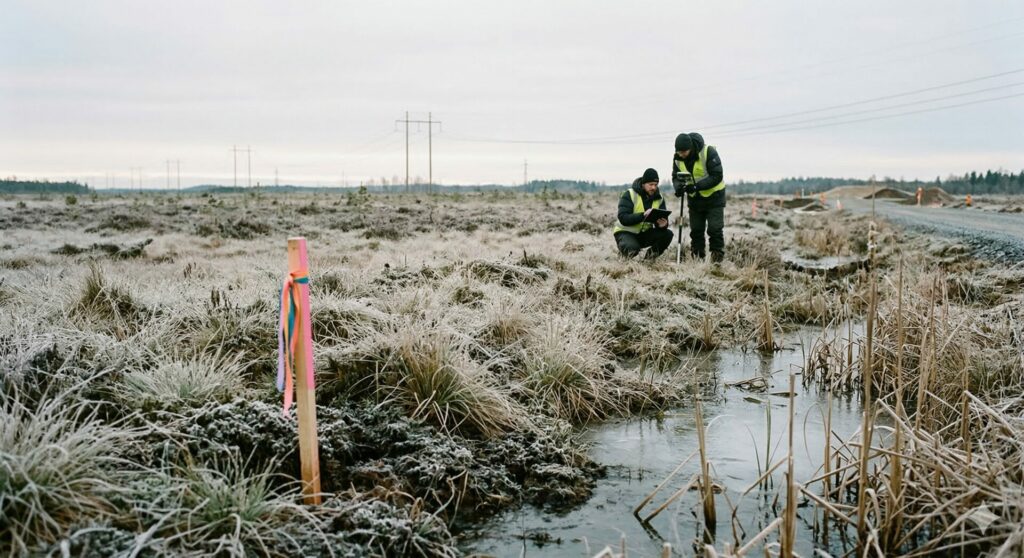
- Ecology, biodiversity and field investigations to identify seasonal survey requirements, potential constraints and issues that could affect acquisition, permitting or programme. Early instruction of ecology consultants can be critical where survey windows are limited.
- Concept development for hyperscale and colocation facilities, including both air-cooled and water-cooled strategies, faster testing of layouts and infrastructure requirements.
- Campus planning informed by local conditions, considering climate, operational requirements and delivery constraints.
- Advisory support that connects commercial priorities with engineering, design, permitting and local delivery considerations, helping project teams move forward with greater certainty.
Designing for Nordic conditions
Building in the Nordics brings environmental and regulatory conditions that can influence both design and delivery. Addressing these factors early helps avoid redesign, programme delays and unexpected costs later in the process.
Common themes we consider early include:
- Seasonal temperature variation, which can influence building envelope strategies and operational performance.
- Moisture management and detailing expectations, particularly around ground floors and perimeter conditions.
- Frost depth, which affects groundworks, insulation and service routing.
- Radon mitigation in certain regions, requiring careful consideration of foundations and ventilation strategies.
- Life safety interpretations by local authorities, which can influence requirements such as smoke management, escape routes and building user safety.
- Snow and ice management at campus scale, including clearance strategies, storage, protection from falling ice, covered pedestrian routes and walkways where needed, and safe access routes for people, plant and operations.
Understanding these conditions early allows project teams to align technical design with local expectations and delivery realities.
Permitting across the Nordics
Permitting processes vary across Denmark, Finland, Norway and Sweden, and these differences can significantly influence site selection, timelines and delivery strategies.
The overview below highlights some of the considerations that commonly shape early-stage planning for large-scale data centre developments.
Denmark
In Denmark, data centre developments need to align closely with local planning frameworks. In many cases, zoning changes are required before projects can proceed to building permits and environmental approvals.

What to consider early:
- Engagement with municipal and local planning authorities will typically be required.
- Dispensation or the preparation of a new local plan may be needed to enable development.
- Depending on the project, an Environmental Impact Assessment (EIA) may also be required alongside building and environmental permits.
Recent changes: - Zoning and EIA triggers remain broadly consistent.
- Recent changes to labour and work permit routes may help support delivery planning for incoming project teams and specialist staff.

Timeline considerations:
In some municipalities, parts of the process can run in parallel, which may help shorten overall timelines. Early engagement with the relevant authorities is important to understand what is feasible locally.
Duration
Paperwork Mountain

Drawings Required
Permit Headache

Finland
In Finland, hyperscale data centre campuses may require a new zoning process and typically involve several permitting stages, including environmental and building permits. Early engagement with local authorities can help clarify how these processes are structured and whether elements can progress in parallel.
What to consider early:
- Zoning change may be required depending on the site.
- Projects may require Environmental Impact Assessment (EIA), environmental permits, chemical permits and building permits.
Recent changes: - Since January 2026, Finland’s permitting system has been reorganised under the Finnish Supervisory Agency (Luova), creating a more centralised approach to environmental permitting.
- A single national authority now co-ordinates environmental permitting, resulting in a single permit decision and a single appeal route.
- Building permits must now be supported by structured machine-readable Building Information Modelling (BIM) data under the fully enforced Building Act 751/2023.
Timeline considerations:
In some cases, zoning and EIA processes may run in parallel, subject to local authority agreement. Early discussions can help determine whether this is possible and how it may affect overall project timelines.
Duration
Paperwork Mountain
Drawings Required
Permit Headache
Norway
In Norway, large-scale data centre developments typically involve several permitting stages, including zoning, environmental permitting and building permits. These processes are often interconnected, and early planning is important to understand how they may interact.
What to consider early:
- Zoning requirements should be reviewed early, as these can significantly influence project timelines.
- Environmental permits may be required and are often coordinated alongside the zoning process.
- Building permits typically follow once the planning framework for the site has been established.
Recent changes: - New facilities coming online after 1 July 2026 must now consider mandatory heat reuse requirements.
- New data centres are now expected to target a Power Usage Effectiveness (PUE) of 1.2 or lower.
- Municipalities are also required to maintain an overview of local heating and cooling needs and support the integration of excess heat.
Timeline considerations:
The zoning process can be lengthy in some cases, potentially taking 18 months or more depending on the site and local planning context. Early engagement with local authorities can help clarify timelines and identify opportunities to coordinate permitting processes.
Duration
Paperwork Mountain
Drawings Required
Permit Headache
Sweden
In Sweden, the planning framework is based on a hierarchy of general and detailed plans. For most large-scale data centre developments, a detailed plan must be in place before a building permit can be granted.
What to consider early:
- A detailed plan is usually required to enable data centre development.
- Establishing a new detailed plan typically involves public consultation and coordination with local authorities.
- Site selection can significantly reduce risk if a suitable detailed plan already exists.
Recent changes: - Data centres with an IT power demand of at least 500 kW are now subject to mandatory reporting under the EU’s updated Energy Efficiency Directive (EED).
- Reporting must cover annual performance data, including Power Usage Effectiveness (PUE), water usage and the percentage of renewable energy used.
- The first mandatory reporting for the full 2025 calendar year must be completed by 15 May 2026.
Timeline considerations:
Preparing or amending a detailed plan can take two years or more in some cases, depending on the site and local planning context. Early engagement with local authorities can help clarify the process and identify potential pathways.
Duration
Paperwork Mountain
Drawings Required
Permit Headache
While permitting processes differ across the Nordic countries, early engagement with authorities and a clear understanding of local planning frameworks are common success factors.
How we work
Delivering data centre projects in the Nordics requires a clear understanding of local planning frameworks, authority expectations and environmental considerations.
We work as part of a wider delivery team, collaborating closely with trusted local partners, consultants and specialist advisors. This approach helps clients navigate permitting processes, coordinate local inputs effectively and move from early site strategy to a clear delivery pathway.

Speak to the team
If you’re assessing Nordic sites, planning a rollout, or working through a permitting strategy, we can help you clarify the path ahead.

Bill Cross
Senior associate

Tony Luck
CFO